
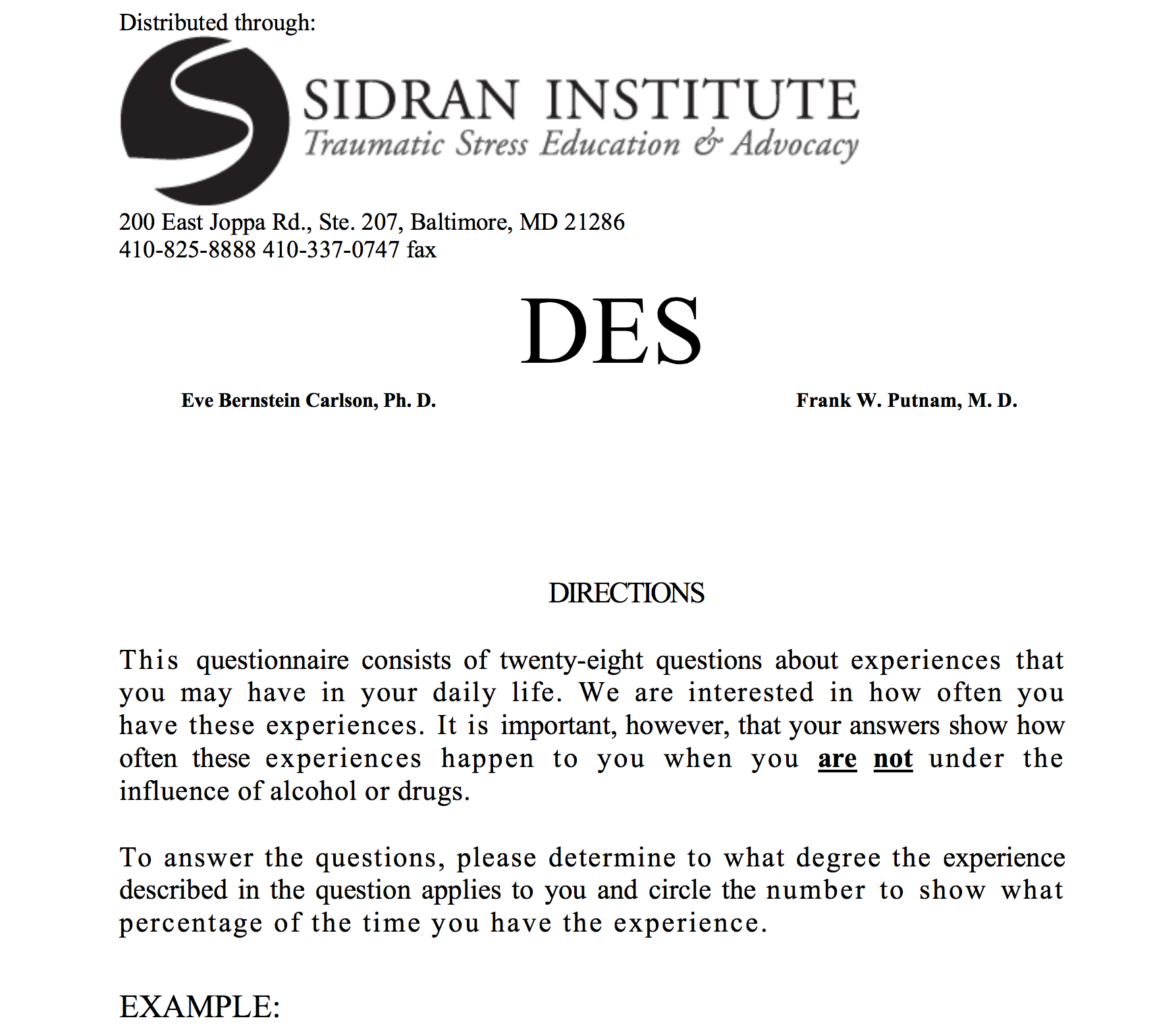
One of the assessment tools we use in EMDR is the Dissociative Experience Scale, or the DES as it is typically called. It has 28 questions that indicate that dissociation or “going away” mentally is likely happening by the client. Typical questions are:
Dissociation is an important issue with EMDR because of the way EMDR works at the neurobiological level. There are many ways to look at this, and it can become very technical and complicated, but suffice it to say that EMDR processing links up neural networks across internal neural boundaries, which is good in some cases but can be problematic in others.
Indeed, one of the main benefits of EMDR is that it links up the “maladaptive” neural networks to the “adaptive” neural networks, so that frozen or stuck memories can link up to new information and healing can take place. The downside is that these boundaries are put in place by the brain/mind mechanism to protect the “self” from being threatened or overwhelmed from the emotions of trauma that is stuck or frozen in the brain/neural nets, and if they are breeched or crossed too soon the result in emotional flooding or abreaction in the client depending on the severity of their dissociation and the rigidity of the boundaries.
This is to say that clients with single issue trauma, or primary dissociation are less likely to be emotionally overwhelmed than are clients with complex trauma. Complex trauma means, essentially that whatever happened was chronic, severe, instigated by humans – usually care givers – and that the mind has set up strong defenses in the brain to guard against feelings those resolved experiences.
In the training, “The Art of EMDR,” Kathleen Martin, LCSW gave the instruction that the best way to administer the DES is to read it to the client as part of a session. This is done in place of handing it to them and having them take it home and do it, or completing it in the waiting room prior to or after a session.
I sent her a follow up email asking was I correct in my understanding that the DES should be read to clients, and if so, why? This was her response:
“Yes, that is correct. It is not a good idea to give the test to them to complete on their own.
When I thanked her for the response and acknowledge that it was more involved than I’d realized, she said, “Great. Treating trauma is complicated!”
Indeed, it is.

Amanda Martin holds a PhD in Family Therapy and is a Licensed Professional Counselor, Licensed Marriage and Family Therapist Supervisor, and EMDRIA Approved Consultant. With over 14 years of experience, she specializes in trauma therapy for individuals and families in residential and outpatient settings. Amanda also provides supervision for EMDR certification, EMDR consultants-in-training, and LMFT-Associates. Her mission is to help people find a healthy, joyful, and fulfilling path in life. Her warm, supportive, and interactive counseling style incorporates Symbolic Experiential Therapy, Trauma-Focused Cognitive Behavioral Therapy, EMDR, HeartMath, Animal-Assisted Therapy, Neurofeedback, and Collaborative Problem Solving.
Dr. Jose Carbajal, a U.S. Army veteran, earned his bachelor’s and master’s degrees in social work and a master’s in theological studies from Baylor University, and a Ph.D. in Social Work from the University of Texas at Arlington. With over 15 years of clinical experience and extensive teaching experience, Jose specializes in trauma, sexual abuse recovery, domestic violence, and substance abuse. His research focuses on trauma interventions, neuroscience, and faith. He is EMDR Certified, an Approved Consultant, and an EMDRIA Approved Trainer, with numerous publications and professional presentations to his name.
Amber holds a PhD in Counselor Education and Supervision from Regent University. She is a Licensed Professional Counselor in both Texas and Oklahoma and holds Supervisor credential for Texas. Amber is an EMDRIA consultant and trainer. She has over a decade of experience in the trauma field in work with uniformed services, domestic violence, childhood trauma and abuse, and recent mass trauma events. Amber provides consultation for EMDRIA certification, for consultants-in-training, and supervision for LPC-Associates. Amber continues to research the benefits of EMDR therapy with a variety of populations. Her goal is to help build strong clinicians who are well versed in trauma interventions to better support their clients. Amber sees a limited number of clients with a focus on trauma work, she is also a Certified Career Counselor and Certified through EAGALA to provide equine-assisted therapy.
Dr. Jose Carbajal, a U.S. Army veteran, earned his bachelor’s and master’s degrees in social work and a master’s in theological studies from Baylor University, and a Ph.D. in Social Work from the University of Texas at Arlington. With over 15 years of clinical experience and extensive teaching experience, Jose specializes in trauma, sexual abuse recovery, domestic violence, and substance abuse. His research focuses on trauma interventions, neuroscience, and faith. He is EMDR Certified, an Approved Consultant, and an EMDRIA Approved Trainer, with numerous publications and professional presentations to his name.
Amanda Martin holds a PhD in Family Therapy and is a Licensed Professional Counselor, Licensed Marriage and Family Therapist Supervisor, and EMDRIA Approved Consultant. With over 14 years of experience, she specializes in trauma therapy for individuals and families in residential and outpatient settings. Amanda also provides supervision for EMDR certification, EMDR consultants-in-training, and LMFT-Associates. Her mission is to help people find a healthy, joyful, and fulfilling path in life. Her warm, supportive, and interactive counseling style incorporates Symbolic Experiential Therapy, Trauma-Focused Cognitive Behavioral Therapy, EMDR, HeartMath, Animal-Assisted Therapy, Neurofeedback, and Collaborative Problem Solving.